
Ko Yong Hui

updated and revised 10 June 2012
Ko Yong Hui (Ko Yo’ng-hu’i) was Kim Jong Il’s 4th wife (consort) and mother of his three youngest children, including current DPRK supreme leader Kim Jong Un.
Ko Yong Hui was born in June in 1952 or 1953 in Osaka, Japan. She was the daughter of a native of Jeju (Cheju) Island who migrated to Osaka in the 1930s, before moving to the DPRK in the 1960s. The identity of Ko’s father is disputed by scholars with some saying she was the daughter of Ko T’ae-mun, a judoist and sports promoter who was credited with introducing judo the DPRK, or Ko Kyo’ng-t’aek, who worked as a factory manager in North Hamgyo’ng Province.

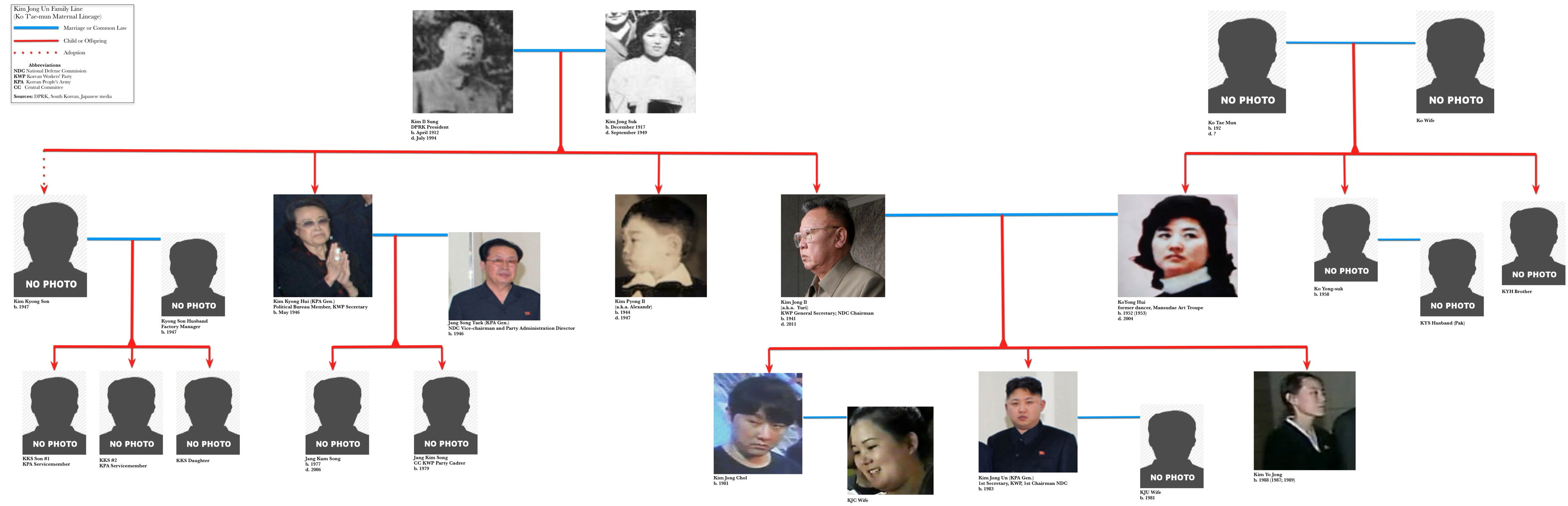
Kim Jong Il-Ko Yong Hui Family, showing the disputed Ko paternal lineages
Ko joined the exclusive Mansudae Art Troupe in the early 1970s. At the time the troupe was under Kim Jong Il’s management. She became a principal performer in the ensemble and played a solo on a changgo. Ko was part of the Mansudae Art Troupe’s 220-member tour of Japan during August to September 1973. Images of Ko’s performance were subsequently used on record (LP) jackets and in a DPRK-published magazine on Korean folk music and dance. Around 1976, Kim Jong Il began his relationship with Ko, who accompanied him to banquets and other close-aide parties. According to the memoir of former dancer, Sin Yo’ng-hu’i, “Ko Yong-hui sat by Kim Chong-il most of times. Until I found she was Ko Yong-hui, I had been very much drawn by her presence — because she came into the dining hall together with Kim Chong-il and Kim Chong-il even helped her personally take her coat off.”
Kim Jong Il established a household with Ko Yong Hui around 1978. In 1981 she gave birth to Kim Jong Chol (Kim Cho’ng-ch’o’l), KJI’s second son. In 1983 she had a second son, Kim Jong Un (Kim Cho’ng-u’n) and in 1987 she gave birth to her last child, daughter Kim Yo Jong (Kim Yo’-cho’ng). Ko and her children primarily lived in residence #22 on Ch’angkwang Mountain near the Korean Workers’ Party’s central complex. With his elder son, Kim Jong Nam, studying in Russia and Switzerland, KJI formed a close bond to his children with Ko. Ko taught her children to cherish, respect and fear their father. Ko also had close ties to members of KJI’s staff. Because of those connections, she became conversant with some of the political and policy issues and machinations in Pyongyang. This established a level of political influence with KJI, and within the country’s central leadership.

Ko (L) with her son Kim Jong Un (R) (Photo: Mainichi Shimbun-Yonhap)
In the early 1990s Ko Yong Hui traveled with her children to Japan. They visited Sapporo, several aquariums and Tokyo Disney Resort. In 1994 Ko was diagnosed with breast cancer and was treated in France. At that time, her son Kim Jong Chol moved to Switzerland where he would study at the International School Berne, among other institutions. He would later be joined in Switzerland by his younger brother, Jong Un, and their sister Yo Jong.
Ko routinely accompanied Kim Jong Il on his on-site visits and military field inspections, acting in the role of first lady. From 2002 to 2006, 150 essays appeared in the DPRK press under the byline “Ko Yong Hui.” Also, during the early 2000s Korean People’s Army [KPA] indoctrination and political education materials began to refer to a “respected mother” who was described as “assisting the Ryo’ngdoja (KJI) from the close quarters of his body.” Both the editorial writing and the “mother of Korea” materials were part of a publicity campaign in support of one of Ko’s sons (presumed to be Jong Chol) as hereditary successor. The campaign was short lived. In 2003 Ko returned to France after her breast cancer recurred. She received a double mastectomy, but the cancer spread and she died in Pyongyang during the summer of 2004.
Sources: Interviews and discussions by Michael Madden; Baird, Merrily. Kim Chong-il Agonistes (Forthcoming 2012); Fujimoto, Kenji and Shin, Hyon-ho. Kim Chŏng-il ŭi yorisa. Seoul: Wolgan Chosonsa, 2003; Mansourov, Alexandre Y. “Inside North Korea’s Blackbox: Reversing the Optics” DPRK Policy Elites (Kongdan Oh Hassig, ed.) Alexandria, VA: Institute for Defense Analyses, 2004; Kokita Kiyohito, Tessa Morris-Suzuki and Mark Selden, “Ko Tae Mun, Ko Chung Hee, and the Osaka Origins of North Korean Successor, Kim Jong Un,” The Asia-Pacific Journal Vol 9, Issue 1 No 2, January 3, 2011; “‘Exclusive interivew’ with Sister of Kim Chong Il’s Wife,” Wolgan Yosong Chungang, November 28, 2000 (in Korean); “AERA Obtains ‘Rare’ Photo of Kim Chong Il’s Wife Ko Yong Hui,” AERA, February 3, 2003, pp. 14-15 (in Japanese); “‘Respected Mother’ in DPRK Document Said to be Reference to Mother of DPRK Heir,” Wolgan Choson March 1, 2003, pp. 117-119 (in Korean); “Kim Jong Il’s Daughter Yo’-cho’ng Also Attended School in Switzerland, Living with Her Borther Cho’ng-u’n During the 1990s,” by Katsumi Sawada, Mainichi Shimbun, January 16, 2009 (in Japanese)


 North Korea Leadership Watch